Over at his place Sullivan has a post up about The Demographics of Death Penalty support, as broken down by race and gender.
The thing that interests me is that black American's support for the death penalty hits a low point in the 60s-70s and then increases through the later 70's and 80's, and starts to come down again in the mid-90's. Just looking at that, I suspect that the pattern roughly follows crime rates. White support for the death penalty, on the other hand, hasn't decreased commensurate with the falling crime rates of the past decade and a half.
Wednesday, October 19, 2011

Sunday, October 16, 2011
A Cocktail For Sunday Night
The George Thomas
or
Old Slow Trot
or
A Chickamauga on the Rocks
3 parts Bourbon (I use 101 proof)
1 part Creme de Peche ( I use GS Massenez)
1 dash bitters (Aromatic lime bitters works best, but Peychaud's will work, I suspect orange bitters would work as well)
Combine ingredients over ice in an old fashioned glass and stir.
This drink is named after General George 'Pap' Thomas, the Virginia-born Union general and 'the Rock of Chickamauga' (hence the alternate name for the drink). I wanted a drink that felt both 'western' and 'southern' hence the bourbon on the one hand and the peach liqueur on the other.
Like it's namesake, it's unassuming and not flashy, but packs quite a wallop when it hits you.
The drink is essentially a 'fancy' cocktail with the curacao replaced with creme de peche. The recipe would work with another whiskey (such as Rye) or Brandy as well.
I'm still tinkering with the recipe -- if you want to 'dry out' the drink, make the ratio of whiskey to Creme de Peche 4/1 rather than 3/1. This is particularly helpful when using Peychauds -- the lime bitters 'lightens' the flavor and the drink can seem rather thick and sweet if Peychaud's are used in the 3/1 ratio.
If making the drink for multiple people I suspect the best ratio is 24/7 whiskey to creme de peche. This is impractical in smaller quantities, however.
or
Old Slow Trot
or
A Chickamauga on the Rocks
3 parts Bourbon (I use 101 proof)
1 part Creme de Peche ( I use GS Massenez)
1 dash bitters (Aromatic lime bitters works best, but Peychaud's will work, I suspect orange bitters would work as well)
Combine ingredients over ice in an old fashioned glass and stir.
This drink is named after General George 'Pap' Thomas, the Virginia-born Union general and 'the Rock of Chickamauga' (hence the alternate name for the drink). I wanted a drink that felt both 'western' and 'southern' hence the bourbon on the one hand and the peach liqueur on the other.
Like it's namesake, it's unassuming and not flashy, but packs quite a wallop when it hits you.
The drink is essentially a 'fancy' cocktail with the curacao replaced with creme de peche. The recipe would work with another whiskey (such as Rye) or Brandy as well.
I'm still tinkering with the recipe -- if you want to 'dry out' the drink, make the ratio of whiskey to Creme de Peche 4/1 rather than 3/1. This is particularly helpful when using Peychauds -- the lime bitters 'lightens' the flavor and the drink can seem rather thick and sweet if Peychaud's are used in the 3/1 ratio.
If making the drink for multiple people I suspect the best ratio is 24/7 whiskey to creme de peche. This is impractical in smaller quantities, however.
Thursday, October 13, 2011
It's not where you're going that matters...
My interlocutor RMB and I are both fond of books many people seem to find dull. Some of them, like Middlemarch, are classics that people don't give a fair shake (perhaps because they're already expecting a boring novel). Others, like O'Brian's Aubriad and Tolkien's Lord of the Rings, are genre classics that many fans of the same genres tell me are too dull to read. They loved the movies, though.
And I have to say that I can see where they are coming from. Neither series of novels is in a hurry to get to the action, and the authors of both seem to think that an anticlimax is the best kind of ending (I happen to agree, but that's another post). But I'd like to focus on one 'boring' feature of both series that I think is actually a great virtue: the amount of narrative space devoted to traveling.
And I have to say that I can see where they are coming from. Neither series of novels is in a hurry to get to the action, and the authors of both seem to think that an anticlimax is the best kind of ending (I happen to agree, but that's another post). But I'd like to focus on one 'boring' feature of both series that I think is actually a great virtue: the amount of narrative space devoted to traveling.
Wednesday, October 12, 2011
The Truth is Not Hidden
In one sense, the battle against 'alternative explanations' for the civil war (ie, those other than slavery) is a battle against belief in hidden truths.
The fact that secession (the more proximate cause of the war) is about slavery is obvious. Alexander Stephens called Slavery (and racial inequality) the 'cornerstone' of the confederacy. The Secession ordinances of just about every confederate state cite their desire to protect slavery. Wartime southern propaganda is redolent with mentions of 'abolition hordes.'
In the North things are admittedly less simple -- the same nation that went marching to war singing 'John Brown's Body' was deeply uncomfortable with emancipating slaves (at first). Yet just because the civil war did not start as a war for abolition does not mean it wasn't a war against slavery. To use the terms of the time, it was a war against slave power and the rebellion that power had spawned, whether or not it involved immediate abolition.
These things are obvious. The effects of the war are even more obvious. And I think that's one reason why people resist saying that 'slavery* caused the civil war.' It's obvious. And many people, particularly intelligent people, resist obvious truths.
I can think of two reasons for this.
The fact that secession (the more proximate cause of the war) is about slavery is obvious. Alexander Stephens called Slavery (and racial inequality) the 'cornerstone' of the confederacy. The Secession ordinances of just about every confederate state cite their desire to protect slavery. Wartime southern propaganda is redolent with mentions of 'abolition hordes.'
In the North things are admittedly less simple -- the same nation that went marching to war singing 'John Brown's Body' was deeply uncomfortable with emancipating slaves (at first). Yet just because the civil war did not start as a war for abolition does not mean it wasn't a war against slavery. To use the terms of the time, it was a war against slave power and the rebellion that power had spawned, whether or not it involved immediate abolition.
These things are obvious. The effects of the war are even more obvious. And I think that's one reason why people resist saying that 'slavery* caused the civil war.' It's obvious. And many people, particularly intelligent people, resist obvious truths.
I can think of two reasons for this.
Wednesday, September 28, 2011
American Heroes
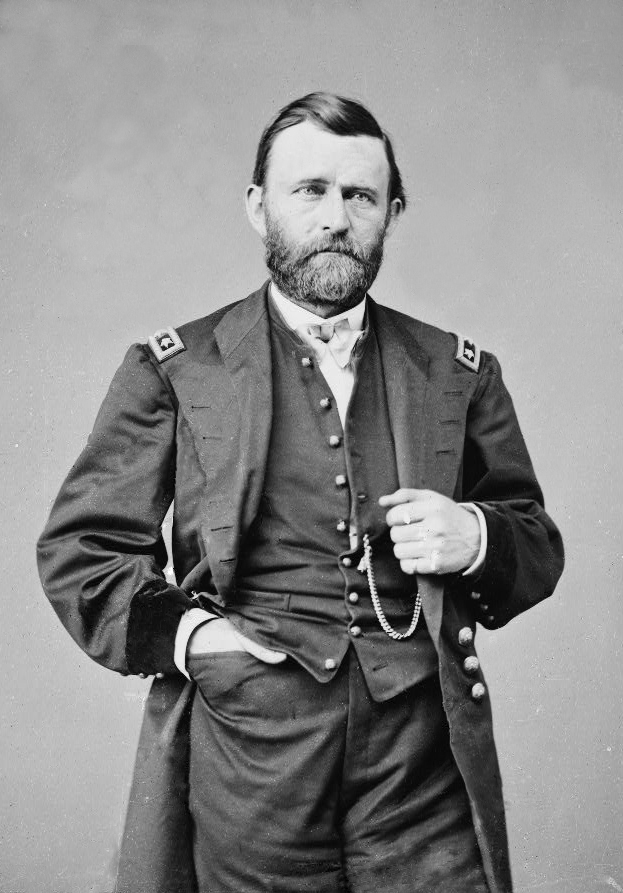
I just finished Grant's memoirs. They are extraordinary, and show an extraordinary mind. They've made me think quite a bit about Grant, and about American heroes in general.
I should preface this by saying that I have not read a good biography of Grant. I know only what I've read in histories of the Civil War and from his own words.
Ta-Nehisi Coates has talked about Grant as a great American hero -- his name is Ulysses, and his initials are US. He's a loving father and husband, functional alcoholic, gifted writer, brilliant general and a failure at everything he tried (save soldiering) until he was nearly 40. He starts the war in a slave-owning family and ends it as a supporter of black solidiers, and as president does more for civil rights than anyone until LBJ some 80 years later. Later, he writes his first and only book while dying of throat cancer, just so his family has enough money to live on when he's gone. They become one of the greatest American bestsellers up to that date, are live on as some of the greatest military memoirs ever.
Friday, September 23, 2011
Military History is Worth Studying, Jim McPherson edition
Recently I was flipping through James McPherson's (of Battle Cry of Freedom fame) Drawn By the Sword, a collection of essays on the Civil War.
They run the normal gamut -- what caused the war, how it was fought, why we remember it, etc. What really jumped out at me, though, was his discussion of why the North Won/Why the South lost.
He contrasts intrinsic explanations for Southern Defeat, which focus on Confederate weaknesses -- the South's relative lack of industry, it's disunity, it's poor leadership -- with extrinsic explanations of Southern defeat, which include Union Strength -- Union Strategic superiority, Lincoln's Leadership, Northern Industry, Northern manpower etc. Ultimately, though, he finds that even the more convincing explanations -- Lincoln's Leadership, Union Material superiority, whatever -- are necessary but not sufficient conditions for Union victory.
As he goes on to say, the sufficient condition for Union victory is battlefield success. Lincoln, a good plan, strong industry and superior manpower were all necessary, but in the end it really did come down to what happened at Gettysburg, or Chattanooga or outside Atlanta.
This is a point that he made implicitly in Battle Cry of Freedom by drawing our attention to these battles as pivotal points in the war. Here he makes the point explicit -- victory hinged on the outcome of batttles, particularly several decisive ones.
This makes the study of those battles not just a fun exercise for hobbyists, but a crucial part of understanding the war. This does not mean that we must study these battles like hobbyists are wont to -- Chancellorsville is not simply a story of Lee and Jackson's geniuses but a very complicated tale of miscommunications, mutual mistakes and bad intelligence. Battles cannot be reduced to generalship, but so much really did hang on how Meade deployed his reserves at Gettysburg, or Thomas holding the line at Chickamauga.
Perhaps the general public does not need to hear this. But from my limited exposure to academic historians, there are quite a few in the Academy that do.
They run the normal gamut -- what caused the war, how it was fought, why we remember it, etc. What really jumped out at me, though, was his discussion of why the North Won/Why the South lost.
He contrasts intrinsic explanations for Southern Defeat, which focus on Confederate weaknesses -- the South's relative lack of industry, it's disunity, it's poor leadership -- with extrinsic explanations of Southern defeat, which include Union Strength -- Union Strategic superiority, Lincoln's Leadership, Northern Industry, Northern manpower etc. Ultimately, though, he finds that even the more convincing explanations -- Lincoln's Leadership, Union Material superiority, whatever -- are necessary but not sufficient conditions for Union victory.
As he goes on to say, the sufficient condition for Union victory is battlefield success. Lincoln, a good plan, strong industry and superior manpower were all necessary, but in the end it really did come down to what happened at Gettysburg, or Chattanooga or outside Atlanta.
This is a point that he made implicitly in Battle Cry of Freedom by drawing our attention to these battles as pivotal points in the war. Here he makes the point explicit -- victory hinged on the outcome of batttles, particularly several decisive ones.
This makes the study of those battles not just a fun exercise for hobbyists, but a crucial part of understanding the war. This does not mean that we must study these battles like hobbyists are wont to -- Chancellorsville is not simply a story of Lee and Jackson's geniuses but a very complicated tale of miscommunications, mutual mistakes and bad intelligence. Battles cannot be reduced to generalship, but so much really did hang on how Meade deployed his reserves at Gettysburg, or Thomas holding the line at Chickamauga.
Perhaps the general public does not need to hear this. But from my limited exposure to academic historians, there are quite a few in the Academy that do.
Wednesday, September 14, 2011
Local Stuff
I live in Annapolis, Maryland. If you live in the DC area, you've probably taken a day trip there, gotten something to eat, walked around town and then gotten ice cream* and gone out for drinks**. At the conclusion of the day you probably said 'hey, that's a really cute town. We should go there again.' And hey, I'm not going to argue.
Needless to say, Annapolis is a tad more complicated for those of us who live here. Rather than talk you ear off about local politics I'm going to mention one specific problem that's been bugging me for a while:

That's former chief justice Roger Brooke Taney, author of the Dred Scott decision, sitting right in front of the statehouse, glowering over the city. Obviously, this is a tad troubling -- it's not really kosher to have a man who said that black people were not American citizens (using the most tortured legal reasoning to do so) immortalized in bronze in front of your statehouse.
Needless to say, Annapolis is a tad more complicated for those of us who live here. Rather than talk you ear off about local politics I'm going to mention one specific problem that's been bugging me for a while:

That's former chief justice Roger Brooke Taney, author of the Dred Scott decision, sitting right in front of the statehouse, glowering over the city. Obviously, this is a tad troubling -- it's not really kosher to have a man who said that black people were not American citizens (using the most tortured legal reasoning to do so) immortalized in bronze in front of your statehouse.
Subscribe to:
Posts (Atom)