Preface: I have been sitting on this for some weeks because, as a guy, I don't want to be That Guy who walks into a conversation about topics important to women and act as though everyone should listen to me; sometimes its better to listen than speak (difficult though that is for someone with my temperament). That said, I wrote it, so I might as well post it.
***
Like a lot of people I've been following the case of Trayvon Martin's killing pretty closely. Unlike many of them, I have nothing intelligent to add.
So I'm going to dredge up a topic of discussion from two news cycles ago and talk about women's health and reproductive rights issues, which I started thinking about more during the whole birth control 'debate' and in that long-ago time when Santorum was actually winning primaries.
I'll start off by saying that I don't have a uterus and thus don't have as much to add to any discussion about abortion or birth control as a woman would -- my opinion on this subject has as much moral force as my opinions on pet grooming. But my opinion has changed a lot over time, and reflecting on my former opinions I think I understand the premises of the pro-life movement better than I might otherwise.
I've noticed that advocates for women's right to have a legal abortions will (justly) focus on the intrinsic sexism of forcing women to use their bodies as incubators for 9 months. Metaphors often conceal more than they reveal, but forcing women to bear all conceived children to term would be a form of indentured servitude inflicted on women, and women only. Thus, it is misogynistic, and those who would enforce this upon women are misogynists.
I have also sometimes heard pro-choice arguments that go on to say that this forced pregnancy is a form of punishing women for having sex, and that pro-lifers believe that women should be punished for 'unchastity.'
Now I would agree with both of the above statements, but I think that both need further explanation, particularly when figuring out how 'pro lifers' view women.
Back in my own pro-life days* I was one of those mushy middle people that didn't think abortion was murder, but thought it should only be legal in certain circumstances. Partly I thought this because finding such a 'middle ground' position made me feel clever, but at a deep level I think that abortion disturbed my moral sentiments --it felt wrong, so I figured it should mostly be illegal. And yet calling it murder would logically dictate that abortion never be legal, even in cases of rape or dangerous pregnancies, and that was also upsetting to said moral sentiments. So I went with what felt right -- abortions for some people some of the time, only if they were pregnant for a certain reason or in a certain (dangerous) way.
It should have upset my moral sentiments that women would be forced to act as incubators for nine months, but it didn't. I reasoned that getting pregnant was a risk of having sex, and that sometimes women would just have to live with it. I wouldn't have framed the above statement in terms of punishment, and I doubt most pro-lifers would, even to themselves, even though 'punishment' is an apt characterization. What's most striking to me about viewing pregnancy as a 'consequence' of sex (other than the logical holes in it) is that I was so easily content with that argument. I don't think I really thought much about what it meant for women.
And I think that's where my own misogyny is most visible. It's not that women were bad or destined to serve men or whatever -- it's that they and their welfare just didn't matter to me. And I suspect that's at the heart of a lot of pro-life feeling today -- women just don't matter. That is what pro-life arguments are -- an attempt to either ignore women completely or minimize them and their experience, so that we can get back to the important business of saving fetuses. It is sexism, whether or not it is attended by overt statements that women are meant for motherhood or that babies are God's punishment for sluttiness. And to me the most convincing argument against such a line of reasoning is to simply point out what it omits -- women -- and to place the rights of women at the center of the question.
*I was teenaged, and had never dated anyone. I was not sheltered by my parents, but the opposite sex was off the radar save in the most furtive way. The idea that people had premarital sex kind of scared me -- not sure where I got this, as I didn't have a conservative upbringing or anything. My prudery was very much my own. Oddly enough, it evaporated over several years as I started dating.
Tuesday, April 10, 2012

Thursday, April 5, 2012
Holy Week Pt 3 - A Painting and a Song for Good Friday
Today is Good Friday. Rather than running my mouth off* I will let Van Der Weyden and Bach speak for themselves.

*I was going to write a longer post about how Bach's St Matthew Passion is a masterpiece of Baroque-era sampling (Bach re-appropriates tunes liberally, not just in the Chorales). But it was a stretch, and has been said before.
Van Der Weyden's Crucifixion Diptych at the Philadelphia Museum of Art. Made for a Carthusian Monastery, it is one of the starkest paintings of its type I've ever seen. In person it actually takes your breath away.
The Opening Chorale to Bach's Matthew Passion. I couldn't find a Youtube recording of "Ach Golgotha" that I liked.
*I was going to write a longer post about how Bach's St Matthew Passion is a masterpiece of Baroque-era sampling (Bach re-appropriates tunes liberally, not just in the Chorales). But it was a stretch, and has been said before.
Wednesday, April 4, 2012
Holy Week Pt 2 -- Religion, Adolescence and Adulthood
In the past few years I find myself in the unaccustomed position of being a believer, but not being very devout. To explain why this feels strange for me it would probably help to explain where I'm coming from, religiously speaking.
I was at my most religious when I was in high school and early college, ages 14-20 or so. My religious beliefs during that time tended toward the extreme -- not in a fundamentalist theological-political sense, but in an absolutist, give-up-everything for God sort of way. I admired the urgency of Jesus' all-or-nothing message in the Gospels, particularly Matthew " "Truly I tell you, it will be hard for a rich person to enter the kingdom of heaven. 24 Again I tell you, it is easier for a camel to go through the eye of a needle than for someone who is rich to enter the kingdom of God.". If you'd asked my when I was 19 what was most important in life, I may well have answered "mystical communion with the divine." Though I wasn't planning on selling my possessions and giving the proceeds to the poor, I felt vaguely bad about not doing so. To me the best life was the most meaningful life, and the most meaningful life was the one tied to the highest things.
I suppose there are several reasons for my adolescent religiosity.
I was at my most religious when I was in high school and early college, ages 14-20 or so. My religious beliefs during that time tended toward the extreme -- not in a fundamentalist theological-political sense, but in an absolutist, give-up-everything for God sort of way. I admired the urgency of Jesus' all-or-nothing message in the Gospels, particularly Matthew " "Truly I tell you, it will be hard for a rich person to enter the kingdom of heaven. 24 Again I tell you, it is easier for a camel to go through the eye of a needle than for someone who is rich to enter the kingdom of God.". If you'd asked my when I was 19 what was most important in life, I may well have answered "mystical communion with the divine." Though I wasn't planning on selling my possessions and giving the proceeds to the poor, I felt vaguely bad about not doing so. To me the best life was the most meaningful life, and the most meaningful life was the one tied to the highest things.
I suppose there are several reasons for my adolescent religiosity.
Tuesday, April 3, 2012
Holy Week pt 1. -- The Strangeness of Liturgy
I grew up in the liturgy of the Episcopal church. I was baptized, confirmed, and married according to the Book of Common Prayer. I've heard the Eucharist service more Sundays than not since I was born, and have witnessed 24 church years progress from Advent 1 to Christ the King Sunday*. Going to church for so long, its rites are as familiar as my family's Christmas or Easter Dinner or the road to the diocesan retreat center in the mountains of Western Virginia.
Being familiar, the rites do not lose their beauty, but I suspect they lose some of their power. The Eucharistic prayer is lovely every time I hear it, but the strangeness of Theophagia is easy to ignore when you've done it 1,000 times before. Religion risks becoming something merely comfortable, which is not exactly appropriate if it is supposed to be an encounter with God.
So I'm glad when Lent and Holy week roll around. The great holidays of Lent -- Ash Wednesday, Palm Sunday, Maundy Thursday, Good Friday -- make me feel as though I'm in some 'exotic' religion from the east, like I'm living out a picture of Divali or another Hindu feast that is outside of my modern, western experience.
Ash Wednesday will never cease to be strange--getting ashes put on your forehead as a priest says "remember thou art but dust, and to dust you shall return" is not something to get used to. And the strangeness continues. Palm Sunday starts with the congregation waiving palm branches and shouting 'Hosanna' and ends with us playing the part of the mob shouting for the blood of our own God*, whose death we give thanks for every Sunday. Maundy Thursday sees us reminded of the weird origins of our weekly Eucharist (and sometimes watching one another's feet) and Good Friday is stark, silent and grim. In Easter the mood does a 180 again, and in some ways it is a Sunday like the rest -- once again a celebration of resurection. Yet it means more because of the preceding week and 40 days before, which serve as a reminder of just how strange our Sunday rituals are.
*Advent is the season before Christmas, and the start of the church year. Christ the King Sunday is the last Sunday before advent.
**I really like this part -- Like the arias of Bach's Matthew Passion, it shows that the sin of all human beings is responsible for the death of Christ, and thus gives the lie to the toxic notion that 'the Jews' killed Jesus.
Being familiar, the rites do not lose their beauty, but I suspect they lose some of their power. The Eucharistic prayer is lovely every time I hear it, but the strangeness of Theophagia is easy to ignore when you've done it 1,000 times before. Religion risks becoming something merely comfortable, which is not exactly appropriate if it is supposed to be an encounter with God.
So I'm glad when Lent and Holy week roll around. The great holidays of Lent -- Ash Wednesday, Palm Sunday, Maundy Thursday, Good Friday -- make me feel as though I'm in some 'exotic' religion from the east, like I'm living out a picture of Divali or another Hindu feast that is outside of my modern, western experience.
Ash Wednesday will never cease to be strange--getting ashes put on your forehead as a priest says "remember thou art but dust, and to dust you shall return" is not something to get used to. And the strangeness continues. Palm Sunday starts with the congregation waiving palm branches and shouting 'Hosanna' and ends with us playing the part of the mob shouting for the blood of our own God*, whose death we give thanks for every Sunday. Maundy Thursday sees us reminded of the weird origins of our weekly Eucharist (and sometimes watching one another's feet) and Good Friday is stark, silent and grim. In Easter the mood does a 180 again, and in some ways it is a Sunday like the rest -- once again a celebration of resurection. Yet it means more because of the preceding week and 40 days before, which serve as a reminder of just how strange our Sunday rituals are.
*Advent is the season before Christmas, and the start of the church year. Christ the King Sunday is the last Sunday before advent.
**I really like this part -- Like the arias of Bach's Matthew Passion, it shows that the sin of all human beings is responsible for the death of Christ, and thus gives the lie to the toxic notion that 'the Jews' killed Jesus.
Thursday, March 15, 2012
Our Wedding: Part IV: Shower and Pre-Marital Dance Party
I'm not a fan of sex segregation, so the prospect of a shower, a hen party, and waiting in the back of the church with crying female relatives were things I wanted to avoid in the process of getting married. As it was, it all worked out great, and I probably could've been less of a jerk about some things, but the end result was indeed that I never ended up alone in a room full of women.
I really didn't want to have a bridal shower - for one thing my lady of honor lived in NYC and I didn't expect her to do anything but show up the day before the wedding, for another I didn't want to spend an afternoon being given stuff labeled "Bride" and getting less-than-stellar advice from female relatives (I think my mother-in-law is as allergic to girly-girls as I am so we get along pretty well in that regard), and finally this wedding involved two people and I didn't want to have a wedding-related party without Will. However, my mom insisted, and Will told me that I needed to grow up, stop being a dick, accept her generosity, and have a shower, so I did.
It was actually a really awesome afternoon, and my mom did a great job (she also did everything, which I feel guilty about looking back). We invited relatives, inlaws, and friends of both genders, and used the afternoon as a way for everyone to get to know each other before the wedding weekend. It felt like a family party with a short bout of gift-giving, and my mom got to show off her taste in interior decorating and cooking. People talked and ate, there was nothing labeled bride or groom, and there were no baby pictures or lingerie.
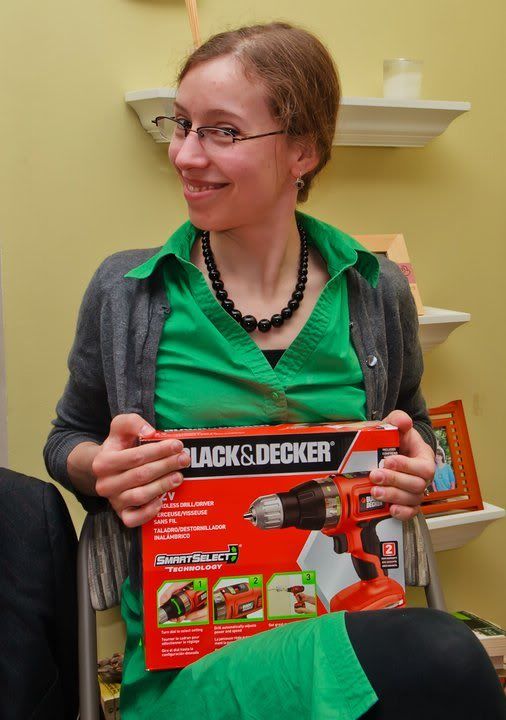
Will asked for glassware, which we got in abundance, and we also got a new toaster oven and a camping lantern. I had specifically asked for tools for shower gifts, so my dad got me a cordless drill. KICKASS.
I really didn't want to have a bridal shower - for one thing my lady of honor lived in NYC and I didn't expect her to do anything but show up the day before the wedding, for another I didn't want to spend an afternoon being given stuff labeled "Bride" and getting less-than-stellar advice from female relatives (I think my mother-in-law is as allergic to girly-girls as I am so we get along pretty well in that regard), and finally this wedding involved two people and I didn't want to have a wedding-related party without Will. However, my mom insisted, and Will told me that I needed to grow up, stop being a dick, accept her generosity, and have a shower, so I did.
It was actually a really awesome afternoon, and my mom did a great job (she also did everything, which I feel guilty about looking back). We invited relatives, inlaws, and friends of both genders, and used the afternoon as a way for everyone to get to know each other before the wedding weekend. It felt like a family party with a short bout of gift-giving, and my mom got to show off her taste in interior decorating and cooking. People talked and ate, there was nothing labeled bride or groom, and there were no baby pictures or lingerie.
Will asked for glassware, which we got in abundance, and we also got a new toaster oven and a camping lantern. I had specifically asked for tools for shower gifts, so my dad got me a cordless drill. KICKASS.
Tuesday, March 13, 2012
The Enemy is Us
Over the past 10 years, the NYPD has shot a number of unarmed (black) men, beat up protestors just for the heck of it, blacked out the media from lower Manhattan, prevented protests from even occurring at the 2004 Republican convention, stopped and frisked untold thousands of people of color without probable cause, gotten their buddies off of parking tickets and then protested when they were censured for it, and now has spied on muslims across state lines for no reason aside form their religion.
And the end result? The NYPD is pretty popular.
To me this illustrates the greatest threat to Liberty -- that the American people will simply hand it over to 'trusted' institutions like the police and the military, partly out of fear for our safety and partly because sentimental regard for those who 'put themselves in harm's way for us' makes criticizing them seem gauche. And why should we not? Most Americans will never have a particularly adverse encounter with a police officer, and the vast majority have nothing to fear from Guantanamo or wire taps. Those who suffer under the heel of these infractions are minorities people neither like nor trust, so in the end the mass of the American people (the white mass) lose nothing personally when the security forces trample the rights of some brown people.
This is all old hat. Tocqueville predicted as much with his memorable coinage 'the tyranny of the majority.' It has been with us in some form since before Andrew Jackson made it an integral part of American politics with his white man's Democracy.
And yet, frustratingly, our cultural discourse doesn't have an expression for this threat. It is all around us and yet movies and films do not warn of the People, but of select cabals that control things behind the scenes. Pop culture is stuck in the anti-establishment politics of the 70's, despite the fact that American politics has moved on. The bad guys in some of the great sci-fi TV of our time - "Firefly," "The X-Files" are behind-the-scenes conspiracies, not the indifferent populace.
Perhaps as my generation comes of age we will see pop culture that reflects the crises of our time and not those of the watergate era. I can only hope. We need a new narrative for new concerns, not one left over from our parents'.
PS: If anyone can think of some great anti-populist media, I'm all ears
And the end result? The NYPD is pretty popular.
To me this illustrates the greatest threat to Liberty -- that the American people will simply hand it over to 'trusted' institutions like the police and the military, partly out of fear for our safety and partly because sentimental regard for those who 'put themselves in harm's way for us' makes criticizing them seem gauche. And why should we not? Most Americans will never have a particularly adverse encounter with a police officer, and the vast majority have nothing to fear from Guantanamo or wire taps. Those who suffer under the heel of these infractions are minorities people neither like nor trust, so in the end the mass of the American people (the white mass) lose nothing personally when the security forces trample the rights of some brown people.
This is all old hat. Tocqueville predicted as much with his memorable coinage 'the tyranny of the majority.' It has been with us in some form since before Andrew Jackson made it an integral part of American politics with his white man's Democracy.
And yet, frustratingly, our cultural discourse doesn't have an expression for this threat. It is all around us and yet movies and films do not warn of the People, but of select cabals that control things behind the scenes. Pop culture is stuck in the anti-establishment politics of the 70's, despite the fact that American politics has moved on. The bad guys in some of the great sci-fi TV of our time - "Firefly," "The X-Files" are behind-the-scenes conspiracies, not the indifferent populace.
Perhaps as my generation comes of age we will see pop culture that reflects the crises of our time and not those of the watergate era. I can only hope. We need a new narrative for new concerns, not one left over from our parents'.
PS: If anyone can think of some great anti-populist media, I'm all ears
Thursday, March 8, 2012
Contraception and Catholicism, Continued - The Anti-Americanism of the Catholic Hierarchy
Catholicism has, over the course of American History, become a vital part of the American landscape. From the Catholic founding father Charles Carroll and his cousin Bishop John Carroll (an early supporter of a vernacular Mass) to President Kennedy, Catholicism made a claim to be a faith compatible with American ideals, and over a century and more it proved itself to be so.

A separation between Church and state came to be welcomed as it allowed Catholics to send their children to Catholic schools, rather than the de-facto protestant state-run schools found in places like Massachusetts. American Catholics embraced democracy and the democratic process, rather than opposing it like many in Europe, who viewed republicanism as inherently anti-clerical. American Catholic churches featured greater lay participation in their management as well.* The Catholic Hierarchy objected to a number of these views, characterizing the American church's tendencies as the heresy of "Americanism", and tried off and on to bring the American church more in line with Rome.**
A separation between Church and state came to be welcomed as it allowed Catholics to send their children to Catholic schools, rather than the de-facto protestant state-run schools found in places like Massachusetts. American Catholics embraced democracy and the democratic process, rather than opposing it like many in Europe, who viewed republicanism as inherently anti-clerical. American Catholic churches featured greater lay participation in their management as well.* The Catholic Hierarchy objected to a number of these views, characterizing the American church's tendencies as the heresy of "Americanism", and tried off and on to bring the American church more in line with Rome.**
Subscribe to:
Posts (Atom)